Common scalp conditions
First, which one is it?
Four conditions account for nearly every itchy, flaky or sore scalp we hear about. See which description fits you.
Dandruff and seborrhoeic dermatitis
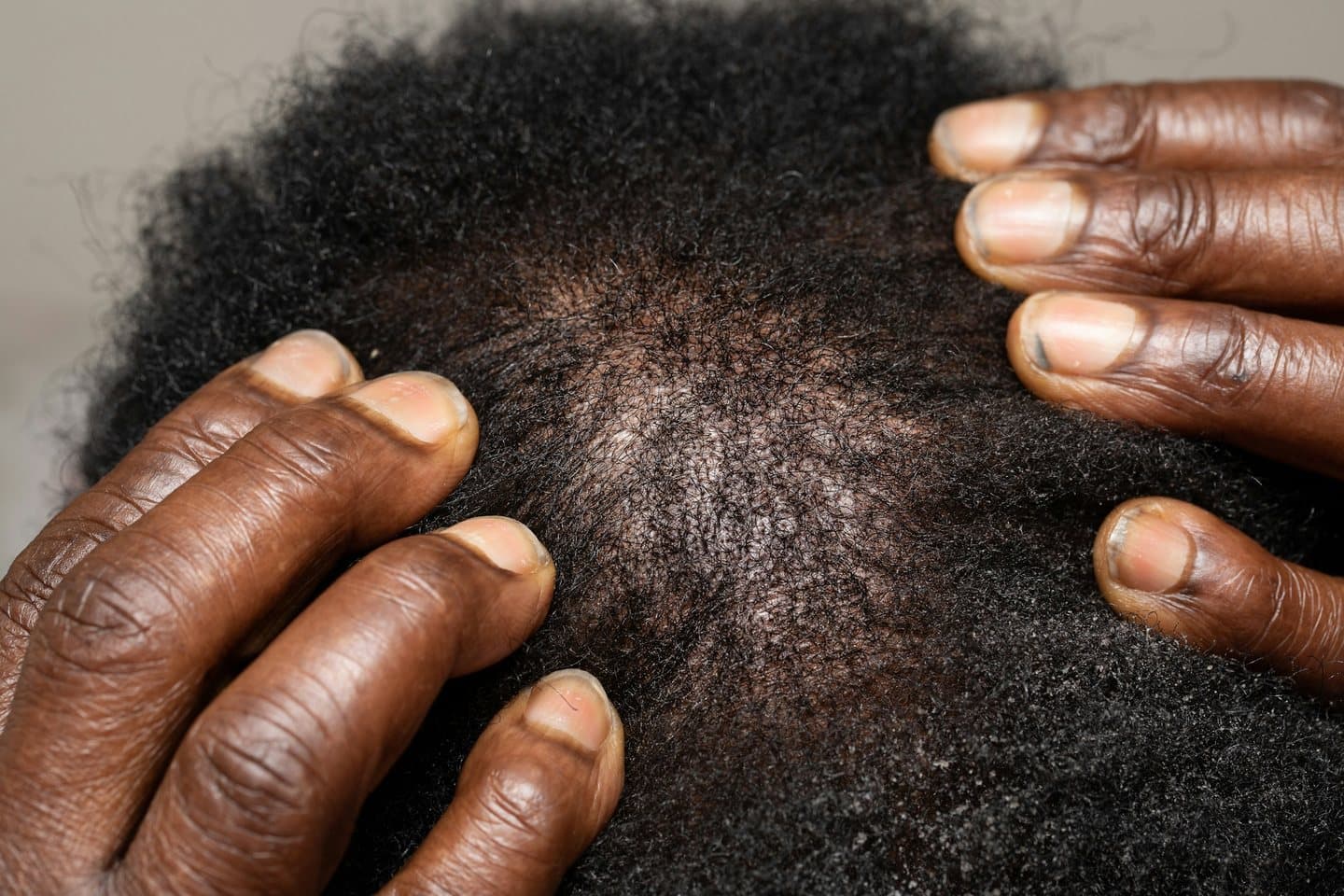
These are the same thing at different strengths. A yeast that lives on everybody's scalp overreacts to the natural oil there, and the skin responds by flaking and itching. At the mild end that's dandruff - fine white flakes, a bit of an itch.
At the stronger end it's seborrhoeic dermatitis - greasy yellowish scale, red patches, real itching, and often the same thing behind the ears, in the eyebrows, or in the creases beside the nose.
It flares with stress, tiredness, illness and cold weather, which is why a long London winter can make it worse and why it comes and goes. It doesn't cause permanent hair loss. An antifungal shampoo such as ketoconazole 2%, used properly, can control it well, but it comes back when you stop, so think of it as maintenance rather than cure.
Scalp psoriasis
Thick, well-defined patches with silvery-white scale, often creeping past your hairline onto your forehead or the back of your neck, with similar patches on your elbows, knees or changes to your nails. Hair does thin within the plaques, partly from the scale and partly from scratching, and it grows back once the psoriasis is controlled.
Mild scalp psoriasis responds to coal tar or salicylic acid preparation from a pharmacy. Anything beyond mild needs your London GP, because the treatments that work best for psoriasis are prescription-only. If you've noticed new joint pain or stiffness alongside it, mention that to your GP too, as psoriasis can sometimes affect joints.
Folliculitis
Small red or pus-filled spots around individual hairs, tender to touch, sometimes after sweating a lot, wearing a helmet or tight hat, or shaving your head. Mild folliculitis usually settles with an antibacterial or antifungal wash and being left alone, so no picking or squeezing.
If spots spread, are painful, keep coming back, or are leaving bald or shiny patches behind, then speak to a GP quickly. There's a rare scarring form of folliculitis that destroys follicles permanently.
Contact dermatitis
Itching, redness and sometimes tiny blisters that start within a day or two of a new hair dye, product or salon treatment, usually worst at the hairline, around the ears and down the neck. The treatment is stopping whatever caused it and seeking advice from your GP. If it was a dye, do a patch test 48 hours before the next one, every time, even with a product you've used before, because dye allergies can develop suddenly and get worse with each exposure.
Scalp treatment
What actually works on the scalp
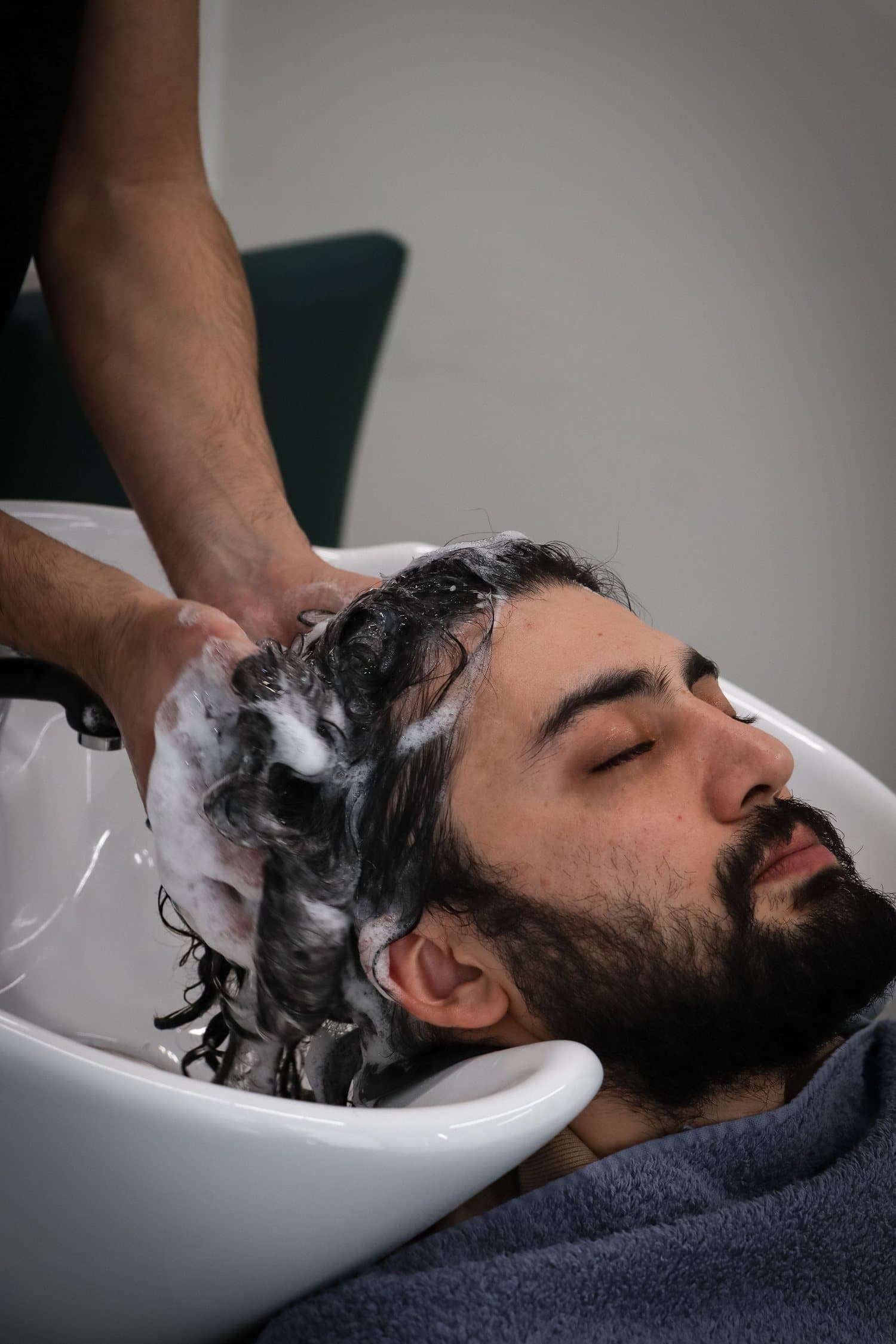
How to use a medicated shampoo properly
Put it on your scalp, not your lengths. Massage it in gently, not with your nails! Leave it on for two to five minutes. Rinse. Do that twice a week for about a month. Once things have settled, drop to once a week to keep it away, and use your normal shampoo the rest of the time.
Which type of shampoo for which problem
| If you have | Try |
|---|---|
| Flakes and an itchy scalp, with or without greasy scale | An antifungal shampoo, most often ketoconazole 2% |
| Thick silvery scales that fit the psoriasis description | A coal tar or salicylic acid preparation, and consult your GP if it's more than mild |
| Small sore spots around the hairs | An antibacterial or antifungal wash |
| A reaction to a product | Stop it immediately |
A pharmacist should be able to confirm what options to consider if you're not sure.
Some people experience scalp and other conditions at the same time - if that sounds like you, read our guide to hair loss treatments in London.
What doesn't help
Scalp scrubs, exfoliating brushes, oils on a dandruff-prone or seborrhoeic scalp, tea tree and apple cider vinegar as a cure, picking and scratching. None of them treat the cause, and most of them irritate the skin you're trying to calm.
What to expect, and when
- Itching and flaking should be noticeably better within two to four weeks of using the right shampoo properly.
- Psoriasis plaques are slower and often need the GP route to settle fully.
- Hair that's thinned from scale or scratching regrows over a few months once the scalp is calm - be patient with it and don't measure it weekly.
- If nothing has changed after a month of doing it right, that's your cue to visit your London GP practice or a trichologist.
Why the supermarket shampoo didn't work
Many people who land on this page have already tried an anti-dandruff shampoo, seen no difference, and quietly decided their problem must be something worse. Usually it isn't. Usually it's the product and the way it was used.
Everyday anti-dandruff shampoos use milder ingredients at lower strength, and they're designed to be used like normal shampoo - lather, rinse, done. Which means they're washed off before they've had time to do much.
A pharmacy-strength antifungal shampoo is a different product, and it's used a different way - massaged into the scalp, left for two to five minutes while you do the rest of your shower, then rinsed, twice a week. It's the same idea, but a completely different result.
And if what you have is psoriasis-type scale rather than dandruff, an anti-dandruff shampoo was never the right tool in the first place. Coal tar, juniper tar or salicylic acid, which soften and lift thick scales, are the ones for that job.
So "nothing works" almost always means "the right thing hasn't been used the right way yet."
Every treatment we've discussed is available from most pharmacies or big supermarkets in London - you don't have to buy from us, we just want you to receive the right advice.
Wash more, not less (if it's dandruff or seborrhoeic dermatitis)
This is the most common mistake we see, and it's the exact opposite of what your instincts tell you.
Faced with a flaky, itchy, sore-looking scalp, most people wash their hair less, to "let it heal" and avoid irritating it, and reach for something soothing, like coconut oil, olive oil, castor oil, a hair mask. It feels like the right thing to do, but for dandruff and seborrhoeic dermatitis it's the wrong move. The yeast behind dandruff and seborrhoeic dermatitis feeds on oil. Washing less leaves more oil on your scalp, adding oil on top feeds it a buffet. Both make the flaking and itching worse, and then people decide the condition is getting more serious.
Instead, do the opposite. Wash more often, not less, with the right shampoo for the problem. Keep oils, masks and leave-in treatments off your scalp. If you like them for your lengths, apply them from the ears down. If your hair is very dry, coily or afro-textured and daily washing isn't realistic, the medicated shampoo still needs to reach your scalp twice a week - just keep the conditioning products off the scalp itself. You can expect a visible difference within two to four weeks.
We know it's easier said than done, but you also need to stop scratching. The itch-scratch cycle breaks hairs at the surface and inflames the skin, so an itchy patch quickly turns into an itchy patch with short, stubby hairs in it, which looks like hair loss even though it may not be. Keep your nails short, and try not to check the spot with your fingers ten times a day. It's the checking that's keeping it angry.
When to see a doctor
When your scalp needs a GP, not a shampoo
Most scalp problems are a pharmacy matter. But some aren't:
- Pain, rather than itch
- Pus-filled spots that are spreading or keep coming back
- Skin that looks scarred, shiny, or smooth where hair follicles used to be
- Hair loss in defined patches, especially with scale or hairs broken off short, which in children and sometimes in adults can be scalp ringworm - this is contagious
- A hairline that's receding while your eyebrows are thinning too
- A scalp that hasn't improved at all after a month of using the right shampoo properly
Patchy loss, a sore or inflamed scalp, or hairline and eyebrow thinning in women should be seen by a GP first. Some of these need a dermatologist and some are time-sensitive, because once a follicle scars, nothing brings the hair back.
If the London Hair Loss Clinic assessment picks up any of them, it won't offer you treatment. It gives you a short, clear list of what to say and ask your GP.
Does an itchy scalp cause hair loss?
An inflamed, itchy scalp can add to your shedding. Scratching breaks hairs and pulls loose ones out early, and inflammation in the skin can nudge some hairs into their resting phase, so they fall a couple of months later. All of that settles once the scalp does, and the hair comes back.
A scalp condition almost never causes the things people are frightened of - the parting that's slowly getting wider, the temples that are creeping back, the crown you can see through under bright lights. That's pattern hair loss.
So if your hair is thinning once your scalp is calm, the scalp wasn't the cause, and it's time to read about female hair loss, male pattern baldness or hair shedding instead, or just take the assessment and let it tell you which.
Scalp treatment FAQs
Not directly. Heavy dandruff or seborrhoeic dermatitis can add a little shedding through inflammation and scratching, and that recovers once the scalp is calm. It does not cause the slow thinning of pattern hair loss, which happens on healthy scalps too.
Essentially, yes. Dandruff is the mild end, seborrhoeic dermatitis the stronger end, of the same overreaction to a yeast that lives on everyone's scalp. Both respond to the same antifungal shampoos.
Dandruff, seborrhoeic dermatitis, psoriasis and contact dermatitis are not contagious. You can't pass them on through pillows, brushes or hugging your children.
Scalp ringworm is contagious, and it's the one that shows up as a red-ringed scaly patch with broken-off hairs, mainly in children. This requires a GP appointment.
Yes, almost always. Hair thins within psoriasis plaques because of the scale and scratching, not because the follicles are damaged, and it regrows over a few months once the psoriasis is controlled. Very long-standing, untreated plaques can occasionally scar, which is one more reason to get it treated rather than put up with it.
You don't need to and it may dry your scalp out. Ketoconazole shampoo works best using it two times a week for a month, left on for two to five minutes, then once a week to keep the condition away. Follow the instructions on the pack or ask the pharmacist in London.
There's some modest evidence that regular ketoconazole shampoo has a small helpful effect in pattern hair loss, probably by calming inflammation around the follicle. It is not a hair loss treatment, but if you have dandruff and thinning hair, it's a sensible shampoo to choose over the alternatives.
A burning, tingling or tender scalp with nothing visible is common. It isn't a skin condition in the usual sense, and often goes alongside hair that's starting to thin or shed. Shampoos won't help because there's nothing on the surface to treat. The London Hair Loss Clinic assessment is the right next step, because the question is really about your hair.
Please note, if the burning comes with redness around individual hairs, or patchy or hairline loss, see your GP instead.
Hair dye can cause breakage, which looks like hair loss but isn't, and an allergic reaction to dye can cause a sore, itchy scalp and temporary shedding at the hairline. Neither causes permanent hair loss on its own. Patch-test before every dye, even brands you've used before, because allergies can develop suddenly.
A dye reaction that spreads beyond the scalp is different. If your face, eyelids or lips start to swell, or you have any difficulty breathing, rinse the dye out immediately and call 111 straight away, or 999 if breathing is affected. This is an emergency, not a shampoo problem, and it can develop within hours of applying the dye.
It can help if you're not sure which condition you have, or if the right shampoo hasn't worked after a month and you'd like someone to examine your scalp in person. A trichologist specialises in hair and scalp problems and can look at your scalp closely under magnification. They aren't medical doctors, though, so they can't prescribe. If your scalp is painful, scarring or covered in spreading spots, see your GP first.
About the author
Kate Holohan
RIT · Cert Ed · Registered Trichologist
Kate Holohan is a registered trichologist and the founder of Hair Therapy UK, an award-winning trichology clinic in Kings Hill, Kent. She has worked with hair and scalps for more than 30 years, first in hairdressing and education. She then trained in trichology with the Institute of Trichologists.
Kate diagnoses and treats hair loss and scalp conditions in adults and children. Her work covers female pattern thinning, shedding, alopecia, hair loss linked to hormones, menopause, thyroid and medication, and scalp conditions such as psoriasis and seborrhoeic dermatitis. She also supports people with medical hair loss from cancer treatment and surgery. She hosts the Hair Therapy podcast, which has more than 200 episodes on hair health and real patient stories. Kate has spoken at the World Trichology Conference.
Her approach starts with a careful consultation to understand what is driving the hair loss before recommending a plan. She works with a wide referral network that includes dermatologists, prescribers and blood-testing services, so people get to the right specialist.
- Professional registration
- RIT (Institute of Trichologists, Registrant)
Medically reviewed
This page was last medically reviewed by Kate Holohan on .

Kate Holohan
RIT · Cert Ed · Registered Trichologist
London Hair Loss Clinic is committed to providing clear, accurate and evidence-based information about hair loss, hair thinning, scalp conditions and their treatment.
Our content is reviewed at least every 12 months to reflect current UK clinical guidance. All treatment pathways described on this website are subject to individual clinical assessment and review.
Read our editorial policy to see how our content is written, reviewed and kept up to date.
